OCR · GCSE · English Literature
Exploring poetry and Shakespeare (02)
OCR Component 02 is your chance to showcase critical analysis of Shakespeare and poetry. This guide breaks down the AOs, gives you clear frameworks for comparison, and helps you turn feature-spotting into high-level analysis.
- 3 min read
- 2 worked examples
- 4 practice questions
- 8 key terms
Study Notes
Overview
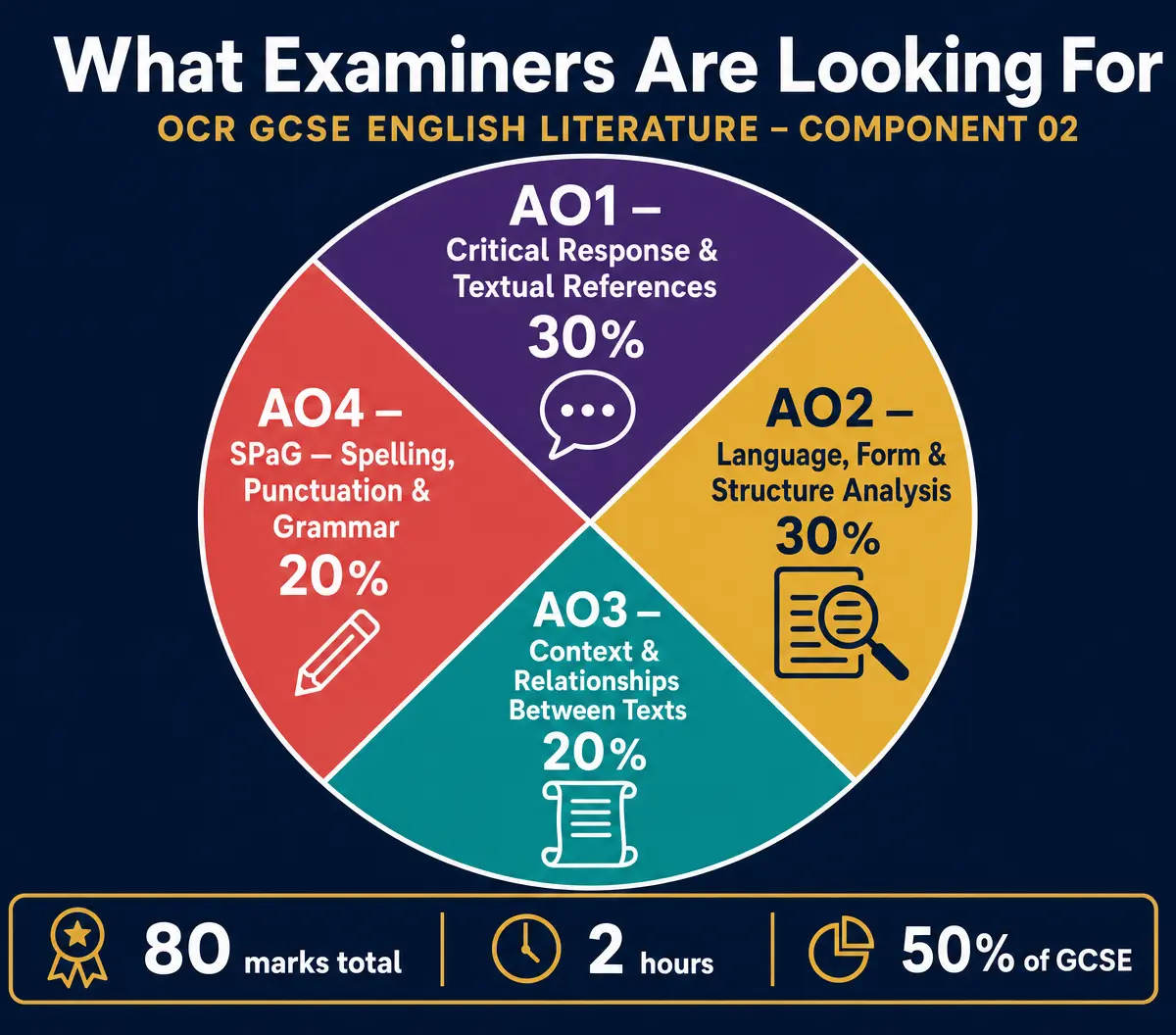
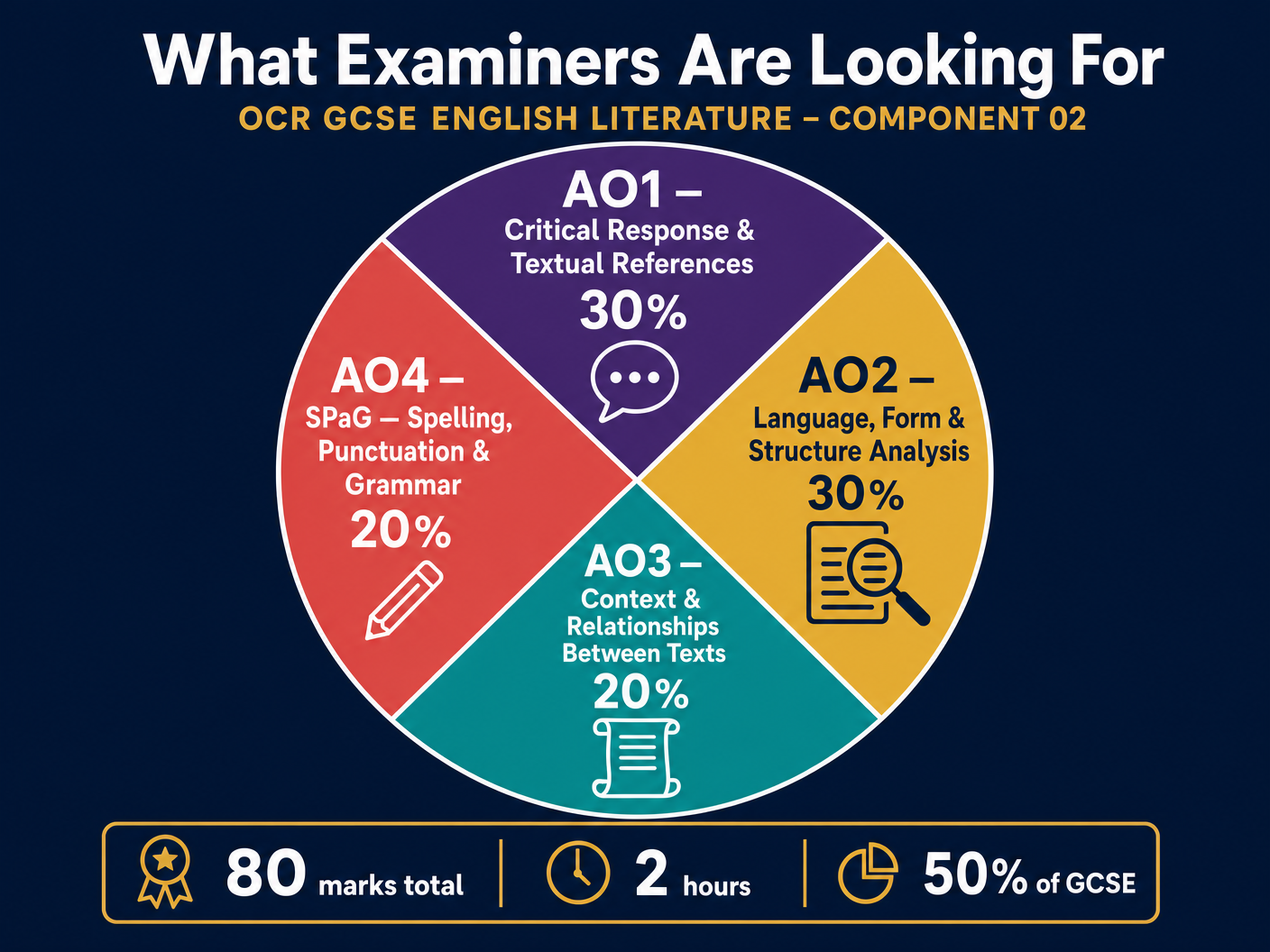
Component 02, 'Exploring poetry and Shakespeare', is a closed-text, 2-hour written examination worth 80 marks (50% of your total GCSE). Examiners are looking for a conceptualised, sustained argument. You must demonstrate a deep understanding of your chosen Shakespeare play and the OCR Poetry Anthology cluster. The assessment is rigorously balanced across four Assessment Objectives (AOs): AO1 (critical response), AO2 (language, form, and structure), AO3 (context), and AO4 (SPaG, assessed on Shakespeare only).
Section A: Shakespeare
The Demands of the Paper
For Section A, you will answer one question on your studied Shakespeare play. This could be an extract-based question, where you must balance your analysis between the provided passage and the wider play, or a discursive whole-text question focusing on a character or theme.
Examiner Expectations
- Sustained Interpretation (AO1): Develop an informed personal response. Do not just retell the plot.
- Close Analysis (AO2): Zoom in on specific dramatic methods. How does Shakespeare use stagecraft, verse vs. prose, or specific imagery to shape audience response?
- Integrated Context (AO3): Connect the text to its Elizabethan or Jacobean context. How would contemporary audiences react compared to modern ones?
Section B: Exploring Poetry
The Comparative Challenge
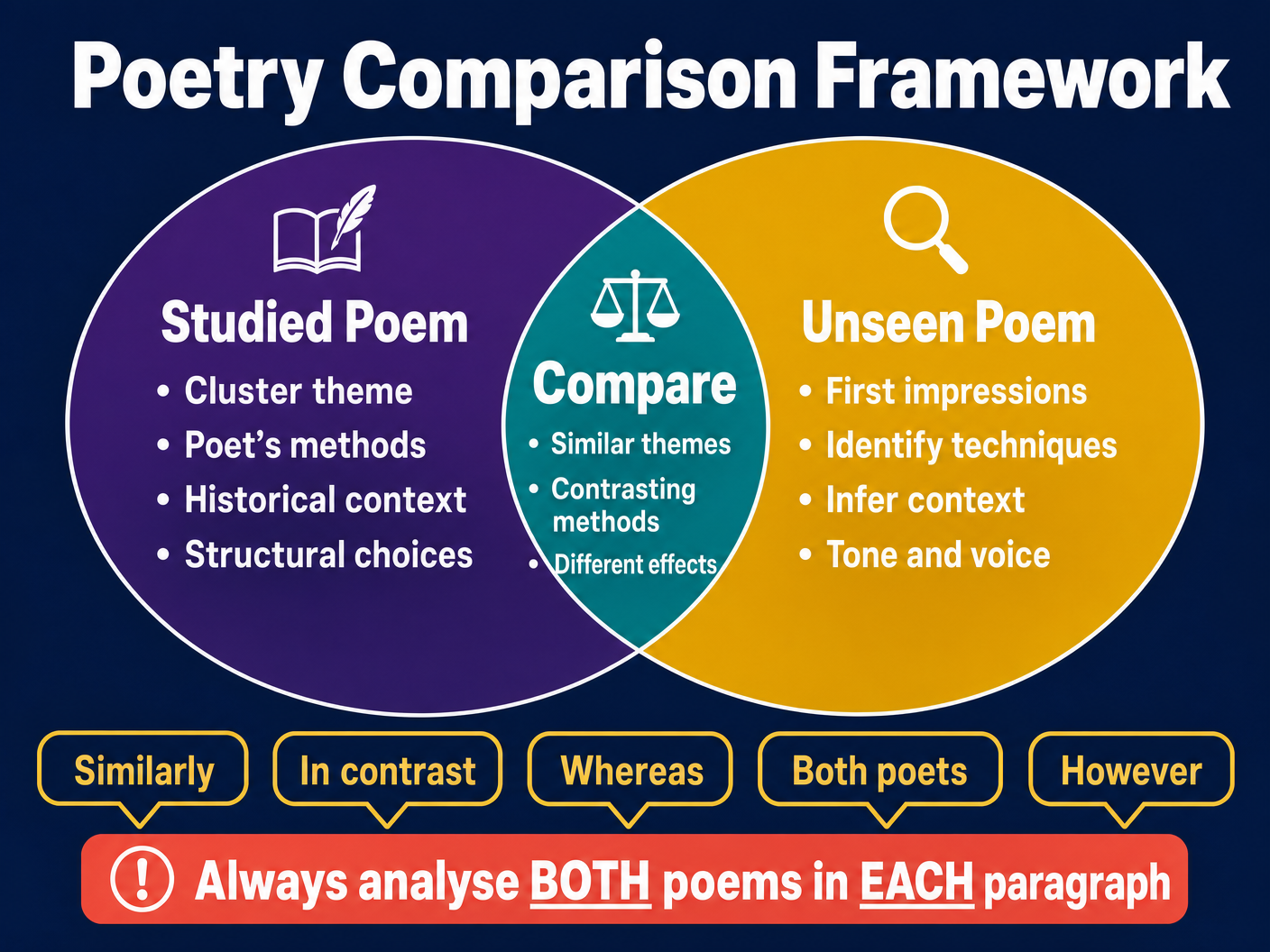
Section B requires you to compare one poem from your studied cluster (Love and Relationships, Conflict, or Youth and Age) with an unseen poem. This is a test of your comparative skills as much as your poetic analysis.
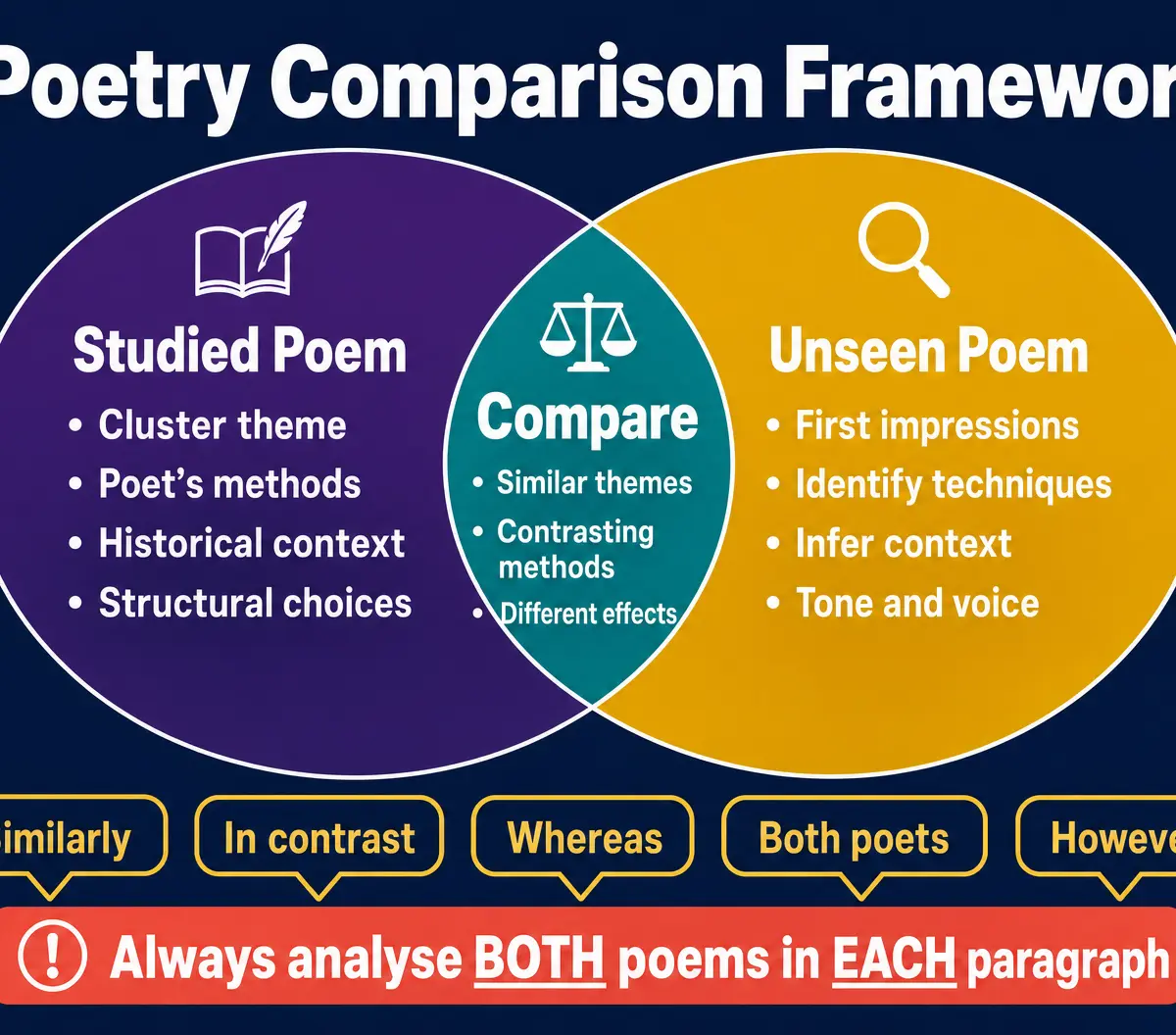
Key Strategies for Poetry
- Discuss Both Poems (AO1/AO2): The most common pitfall is writing about the poems sequentially. You must compare them in every paragraph using comparative connectives.
- Analyse Form and Structure (AO2): Do not just focus on language. Does the poem use enjambment to reflect a lack of control? Is it a rigid sonnet reflecting tight constraints?
- Contextual Links (AO3): How do the poets' backgrounds or the eras in which they wrote influence their perspectives on the theme?
Writer's Methods (AO2)
Examiners heavily reward candidates who move beyond 'feature-spotting'. Identifying a metaphor is Level 2; explaining why that specific metaphor is used and what effect it creates pushes you into Level 4/5.
Structuring Your Analysis
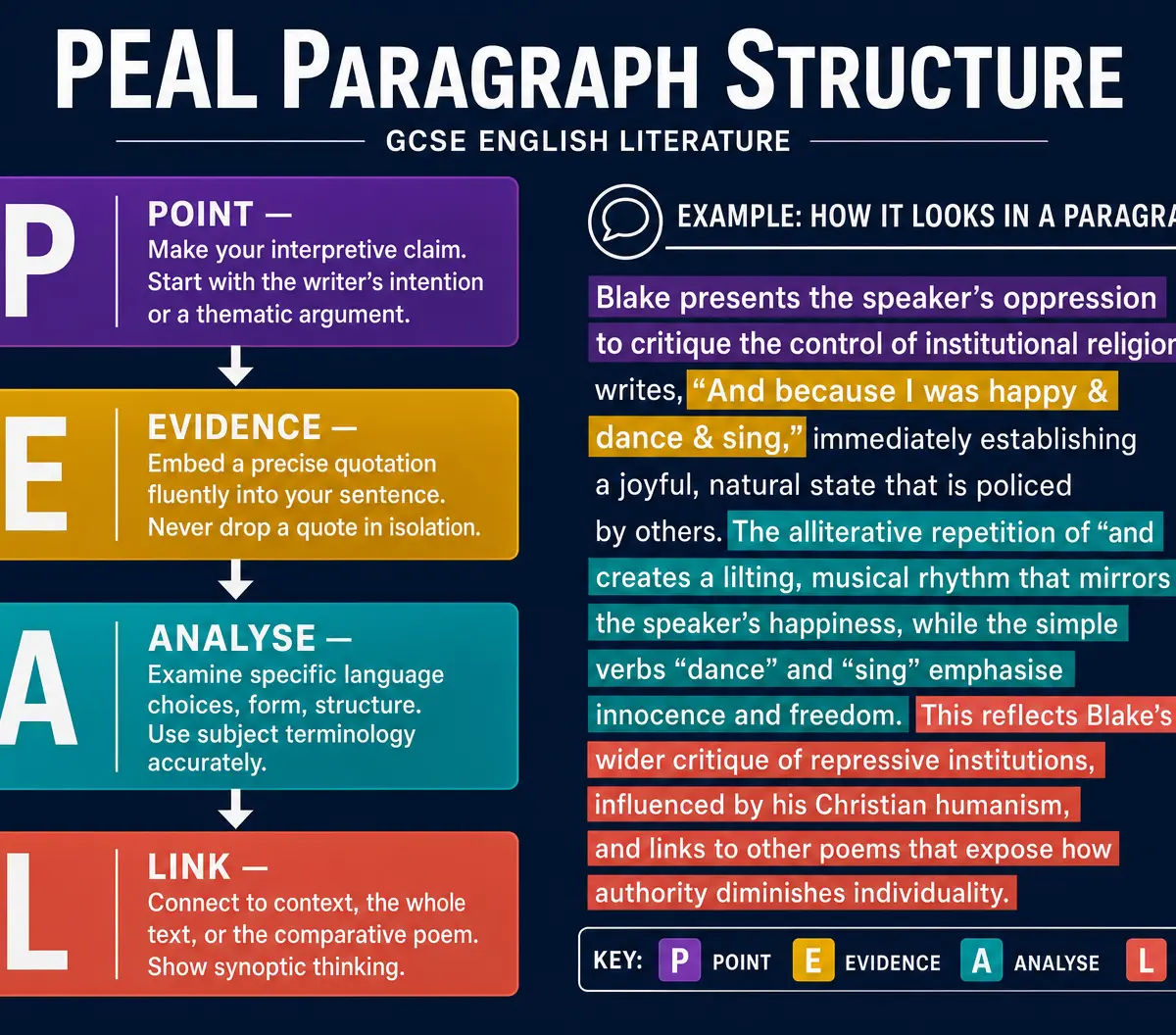
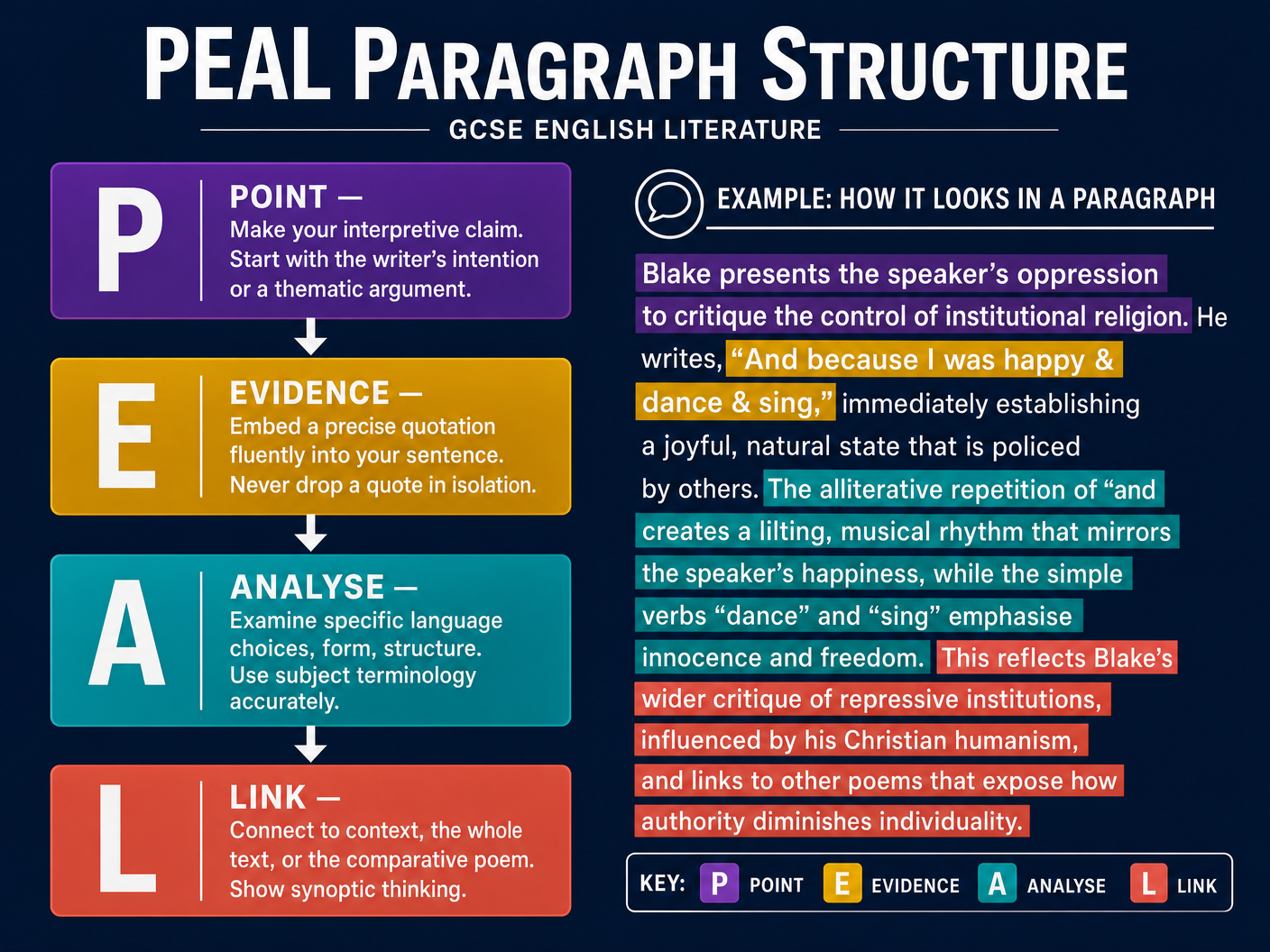
Use the PEAL structure to ensure you hit all AOs:
- Point: Make a conceptual claim.
- Evidence: Embed a precise quotation.
- Analyse: Examine the writer's methods (AO2).
- Link: Connect to context (AO3) or the comparative text.
Visual Resources
3 diagrams and illustrations
Interactive Diagrams
1 interactive diagram to visualise key concepts
Conceptual Flow Outline
The Progression of Deep Analysis (AO2 to AO3)
Worked Examples
2 worked examples — open one to explore the question and available guidance.
Practice Questions
Test your understanding — click to reveal model answers
Starting with this extract, explore how Shakespeare presents the relationship between [Character A] and [Character B].
Hint: Look for shifts in power dynamics in the extract, and track how this relationship evolves or deteriorates across the whole play.
Compare how poets present the power of nature in [Studied Poem] and the unseen poem.
Hint: Consider whether nature is presented as a destructive force, a healing force, or an indifferent force in both poems.
How does Shakespeare use the supernatural to create tension in the play?
Hint: Focus on audience reaction. How would a Jacobean audience react to the supernatural compared to a modern audience?
Compare how the writers present the passing of time in [Studied Poem] and the unseen poem.
Hint: Look at the structure of the poems. Does the poem move chronologically? Are there flashbacks? Does the rhythm speed up or slow down?
Test your understanding of Exploring poetry and Shakespeare (02)
Active recall beats re-reading. Take an instant quiz now to test what you’ve learned and lock it into long-term memory.
7 days Premium · Then free forever · No card, no charge